
Page authority (PA) is a score from 1 to 100, created by Moz, that predicts how well a specific page will rank on search engine results pages. Higher scores mean the webpage is likely to perform better in search results.
It's a third-party estimate, not a number Google publishes. That distinction shapes almost everything else on this page.
What is page authority?
Page authority measures the ranking strength of one specific page, based on the backlinks pointing at it.
Moz built the metric so SEOs could compare individual pages the way search engines might weigh them. A webpage with 400 backlinks from trusted websites is, all else equal, in a stronger position than one with three. PA compresses that backlink profile into a single number you can scan.
Two things it isn't:
- It isn't a Google metric. Google doesn't use page authority and has never published a public equivalent. PA is Moz's model of ranking strength, built from Moz's own crawl of the web.
- It isn't an absolute target. A PA score of 35 is weak in one market and dominant in another. The number only means something next to the other pages competing for the same search queries.
How is page authority calculated?
Page authority is a machine learning model trained on link data from Moz's Link Explorer index. Moz feeds it dozens of link-based signals, then tunes the model to best correlate with actual Google rankings across thousands of live search engine results pages.
The signals that drive the score are all about links:
- Linking root domains. How many distinct websites link to the page. This is the heaviest input: fifty backlinks from one domain count for far less than fifty backlinks from fifty different root domains.
- Total number of inbound links. The raw count, including multiple links from the same website.
- The quality of the linking pages. A link from a page with higher authority passes more value than one from a scraped directory. Pages with higher scores make the pages they link to stronger.
Just as important is what page authority ignores. PA doesn't look at your content, your keyword usage, your title tags, your page speed, or how recently you updated the page. Content quality matters enormously for how you actually rank in search engines. It just isn't an input to this particular score.
The scale is logarithmic
Growth isn't linear. Climbing from 20 to 30 might take a handful of good links. Climbing from 70 to 80 can take hundreds. Most pages on the web sit in the low single digits, and a brand new webpage starts at 1.
That's why chasing a round number is a poor goal. Beating the pages ranking above you is a better one.
What is a good page authority score?
There's no universal good page authority score, because PA is comparative by design. A good page authority is a few points higher than the pages currently outranking you in search results.
Here's a rough sense of what the bands look like in practice:
| PA score | What it usually means |
|---|---|
| 1-10 | New or barely linked. Most pages on the web live here. |
| 10-25 | A normal page on an established website with some internal linking. |
| 25-40 | A page that has earned real external links. Competitive for mid-difficulty terms. |
| 40-60 | A strong asset, such as a well-linked guide, tool, or study. |
| 60+ | Rare. Usually major publications, reference sites, or long-standing landing pages. |
Treat these as orientation, not benchmarks. Higher scores signal a stronger backlink profile, not better content. Before deciding what you need, search your target keyword, check the PA score of the individual pages on page one, and aim above them.
Page authority vs domain authority
The two answer different questions, and people mix them up constantly. Domain authority is the website authority metric; page authority is the page-level one.
| Page authority (PA) | Domain authority (DA) | |
|---|---|---|
| What it scores | A single page | An entire website |
| Question it answers | How strong is this webpage? | How strong is this entire domain? |
| Best used for | Comparing individual pages in a SERP | Comparing websites, vetting link building prospects |
| Moves when | That page earns or loses backlinks | The entire website earns or loses backlinks |
A website with high domain authority doesn't automatically give every page a high PA score. A brand new blog post on a DA 80 website still starts near the bottom. It inherits some website authority through internal links, but it has to earn its own.
The reverse happens too. A single page on a small site can carry a page authority score well above its domain authority.
How to check page authority
Page authority is Moz's metric, so the most accurate page authority checker is Moz's own:
- Moz Link Explorer. Paste any URL into this page authority checker and get its PA score, DA, linking root domains, and top backlinks. The free tier allows a limited number of queries per month.
- MozBar. A free Chrome extension that overlays PA and DA directly onto search engine results pages. This is the fastest way to size up a SERP before you commit to writing.
- Moz Pro and the Moz API. For checking page authority in bulk across many URLs.
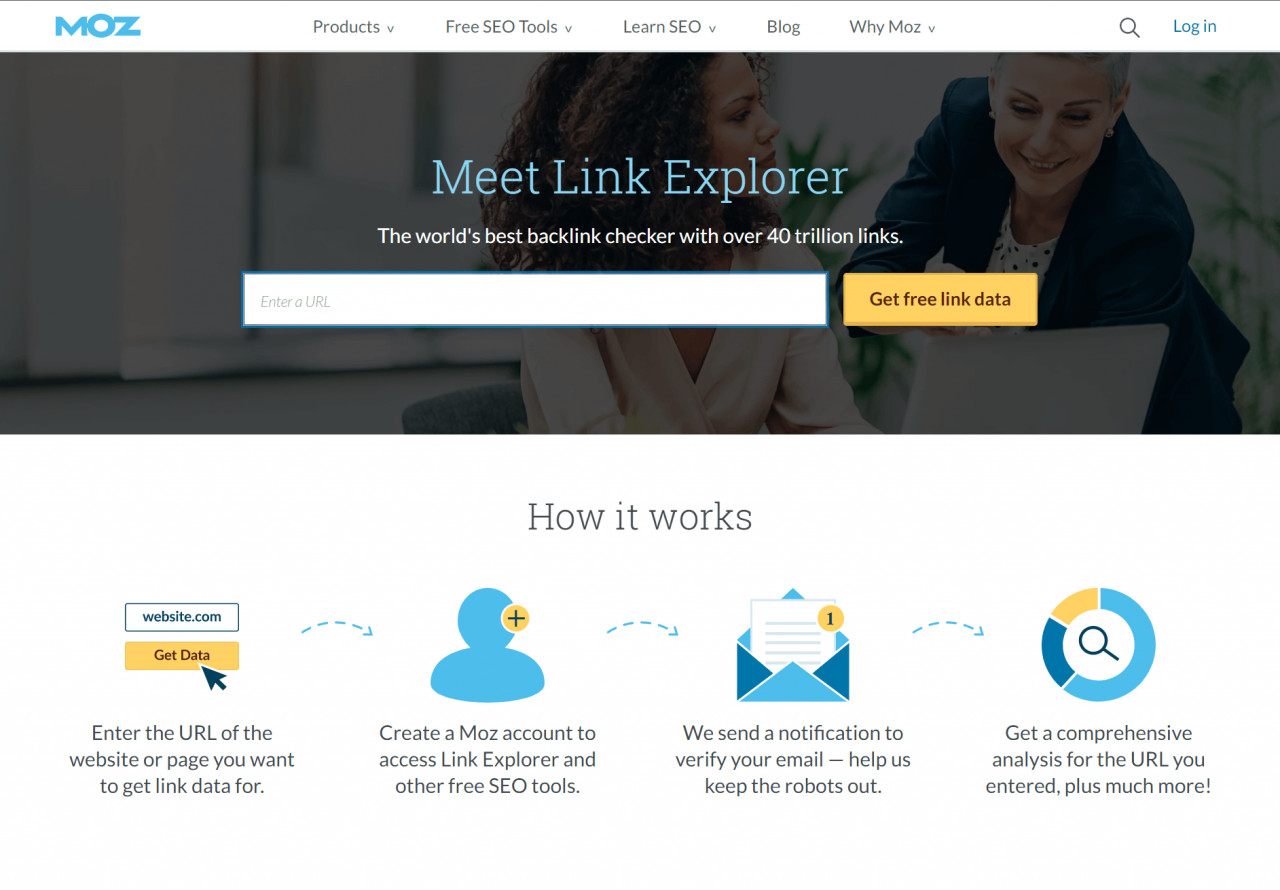
Plenty of free DA/PA checkers exist elsewhere. Most pull the same numbers from the Moz API and rate-limit hard, so treat them as the same data delivered less reliably.
Equivalent metrics in other tools
If you don't use Moz, every major SEO platform has its own website authority metric. They aren't interchangeable, because each website authority score is built on a different crawl of the web, but they measure roughly the same thing:
| Tool | Page-level metric | Domain-level metric |
|---|---|---|
| Moz | Page Authority (PA) | Domain Authority (DA) |
| Ahrefs | URL Rating (UR) | Domain Rating (DR) |
| Semrush | Authority Score (URL) | Authority Score (domain) |
| Majestic | Trust Flow / Citation Flow | Trust Flow / Citation Flow |
Never compare a Moz PA score against an Ahrefs domain rating, or a domain authority against a domain rating, and conclude anything from it. Pick one tool and stay consistent.
How to improve page authority
PA is a link metric, so improving it means improving that webpage's backlink profile. There's no shortcut around it, which makes link building a core part of any SEO strategy aimed at competitive terms.
Earn external backlinks
This is the single biggest lever. Links from websites with higher authority are what move PA, and links from new root domains move it more than additional links from domains that already link to you.
The durable way to get them is to publish something worth citing: original data, a genuinely useful free tool, or a guide that goes deeper than anything else ranking. See our guide on how to get quality backlinks for tactics that won't get you penalised.
Build internal links
Not only do you want external backlinks, internal links are just as important in boosting your link profile. They pass authority between your own pages, and they're entirely within your control. If you have a high-PA page, linking from it to a page you want to strengthen redistributes some of that value across your site.
Always use descriptive anchor text, "page authority" rather than "click here", so both readers and search engines understand what they're being sent to.
Consolidate instead of duplicating
If three thin pages target the same topic, they split whatever links they attract three ways. Merging them into one page and redirecting the others concentrates that authority into a single, stronger URL with one combined link profile.
Don't buy links
Paid link schemes are the fastest way to a manual action. Your PA score might tick up briefly, but your rankings won't survive it.
Why your page authority dropped
A falling PA doesn't necessarily mean the page got worse. The usual causes:
- Moz updated the model or refreshed the index. Scores shift across the whole web when this happens. If everyone in your SERP dropped, nothing is wrong.
- Competitors gained backlinks faster than you. Page authority is relative, so standing still means falling.
- You genuinely lost inbound links. A site that linked to you removed the link, went offline, or was itself deindexed.
Check the pages you compete with before reacting. If their scores moved the same way on the same day, it was Moz, not you.
Should you optimise for page authority?
Optimise for the thing PA is trying to predict, which is rankings, not for the number itself.
Page authority is a useful, fast proxy for how hard a SERP will be to break into, and a reasonable way to vet a link prospect. It's a poor KPI, because it measures one input to ranking and ignores everything about the page itself: relevance, depth, structure, and whether the content actually answers the query.
A strong backlink profile gets you into contention. Content that matches search intent is what wins the click. Dashword helps with the second half, analysing the pages already ranking and showing you what your draft is missing before you publish.
Frequently asked questions
Is page authority a Google ranking factor? No. It's Moz's prediction of ranking ability, calculated from Moz's own link index. Google neither uses nor recognises it.
What is a good page authority score? Higher than the pages outranking you for your target keyword. There's no universal threshold, so check the search engine results pages you actually want to win.
How long does it take to increase page authority? Moz refreshes its link index regularly, so new backlinks usually show up in your PA score within a few weeks. Meaningful movement, rather than a point or two, takes months of sustained link building.
Can I have high page authority and still not rank? Yes, and it's common. Links get you considered, then relevance and content quality decide the order. A high page authority score on a page that doesn't answer the query will lose to a weaker page that does.
Does domain authority affect page authority? Indirectly. A website with strong domain authority tends to pass more value through its internal links, so new pages on it start higher than they would elsewhere. But each page still has to earn its own backlinks to climb.